Thursday, May 25, 2006

No way to bring it to book


70 years ago, Chesterton wrote this brilliant piece on the inherent dangers of theatre and cinema. The man (C.S Lewis who in his autobiography credited Chesterton as a leading influence called him 'the most sensible man alive' though they never met) is prescient and as prophetic as always. Film critic Peter Chattaway whose blog I enjoy immensely reposted an excerpt as a comment on that hit movie:
The second fact to remember is a certain privilege almost analogous to monopoly, which belongs of necessity to things like the theatre and cinema. In a sense more than the metaphorical, they fill the stage; they dominate the scene; they create the landscape. That is why one need not be Puritanical to insist on a somewhat stricter responsibility in all sorts of play-acting than in the looser and less graphic matter of literature. If a man is repelled by one book, he can shut it and open another; but he cannot shut up a theatre in which he finds a show repulsive, nor instantly order one of a thousand other theatres to suit his taste. There are a limited number of theatres; and even to cinemas there is some limit. Hence there is a real danger of historical falsehood being popularized through the film, because there is not the normal chance of one film being corrected by another film. When a book appears displaying a doubtful portrait of Queen Elizabeth, it will generally be found that about six other historical students are moved to publish about six other versions of Queen Elizabeth at the same moment. We can buy Mr. Belloc's book on Cromwell, and then Mr. Buchan's book on Cromwell; and pay our money and take our choice. But few of us are in a position to pay the money required to stage a complete and elaborately presented alternative film-version of Disraeli. The fiction on the film, the partisan version in the movie-play, will go uncontradicted and even uncriticized, in a way in which few provocative books can really go uncontradicted and uncriticized. There will be no opportunity of meeting it on its own large battlefield of expansive scenario and multitudinous repetition. And most of those who are affected by it will know or care very little about its being brought to book by other critics and critical methods. The very phrase I have casually used, 'brought to book', illustrates the point. A false film might be refuted in a hundred books, without much affecting the million dupes who had never read the books but only seen the film.

Tuesday, May 23, 2006

MyKad mystery

First, there were the glitches. Inexplicable errors affecting hundreds of people who found themselves listed with the wrong religion. Hundreds of Christians in churches across the country found themselves identified as Buddhists, Sikhs, or Muslims. My sis-in-law who lectures in a bible seminary had ‘Buddha’ on her MyKad for reasons no one understands. Others found themselves religionless. Human error? On a document as important as an ID? Makes you wonder. Especially when other faith communities have not reported as many problems with their own cards.

While the authorities fall over themselves explaining this as a simple slip-up sans malice, more reports surfaced – MyKad Ids without photos, faces without names (what a hoot - 13-year old Elliot is nameless too!), etc.

And now this.

This is almost too hard to believe: over 2 million Mykad IDs lost since 2001. According to this news report, they add up to a whopping RM75m. No kidding. And this is the card that the government insists is as good as a passport, if not a ‘sophisticated travel document.’

Monday, May 22, 2006

Da marketing blitz

Jonathan Bock has certainly done an outstanding job promoting the Da Vinci movie via a kind of anti-Da Vinci dialogue blog. Barbara Nicolosi is enraged and she’s calling names. Hat tip to GetReligion for this link to Peter Boyer’s very interesting behind-the-scenes backgrounder on the origins of the movie’s marketing blitz:

That is precisely what annoys Barbara Nicolosi, a screenwriter and an influential Christian blogger, whose friendship with Jonathan Bock has been strained recently. She says that when she first heard that Bock was working with Sony on “The Da Vinci Code” she was optimistic. Bock’s connection with the project suggested to her that Sony wanted to mollify Christians, and Nicolosi urged her friends and readers to withhold judgment on the film; perhaps Ron Howard and his screenwriter, Akiva Goldsman, would not use the name Opus Dei, and would make the assertions about Jesus and Mary Magdalene seem more speculative and less factual. Then, she says, someone slipped her a version of the screenplay, and she realized that the studio’s effort to engage in a dialogue with the faith community would be limited to the Da Vinci Dialogue Web site created by Bock. Nicolosi felt that Christians had been sold out, as she proceeded to make clear on her blog. “Christians being coaxed into writing anti-DVC pieces on a stupid web site . . . are meekly accepting that they are being given ‘a seat at the table’ in some grand cultural discussion,” she wrote. “Duped! There is no seat, folks. There is no discussion. What there is, is a few P.R. folks in Hollywood taking mondo big bucks from Sony Pictures, to deliver legions of well-meaning Christians into subsidizing a movie that makes their own Savior out to be a sham.”

Nicolosi says that those participating in the Sony project are debating “on Hell’s terms,” and she refers to the Web site’s contributors, some of whom are her friends, as “useful Christian idiots.” [More]

Writing as an advertising professional, the marketing triumph proves that there is no such thing as bad publicity. Or controversy. It also proves that if you can’t convert people to your side, at least make them your friends.

How do you deal with this? Denounce the sham that is the Da Vinci Dialogue, or embrace it as legitimate engagement? After all, isn’t it better to speak up and defend historic Christianity than clamming up and have someone else define their own version of it?

Sounds a little like evangelicals and emergent folks throwing stones across the orthodoxy divide.

Review: Steven Greydanus's 'Your mother's a whore' last words.


Thursday, May 18, 2006

Capote Vs Barrie


I’m in a bit of a fix: what movie should I screen for the forthcoming Young Writer’s Camp end of May? It’s a session on understanding worldviews which I thought would be better served by a movie than a lengthy lecture.

I’ve had suggestions to screen Memento (mind twisting), A Beautiful Mind (couldn’t stand Crowe in this one), and Fight Club (R-rated). Now I’m going to be speaking to campers between 12 and 19 years (facilitators excluded). So, as much as I think Fight Club makes for an interesting and soul-searching discussion, screening it would get be flayed and quartered.

Then there were suggestions of Tuck Everlasting (too childish), Babette’s Feast (excellent, but I screened it once to college kids and they called it an ‘auntie movie’), Seven (too morbid) and even Kung Fu Hustle ( too common, but I have to admit I enjoyed it). Someone asked for V for Vendetta (but I don’t have the dvd). Should I even think about Rashomon, or maybe Purple Rose of Cairo?

Decisions, decisions. 2 hours for a movie. 45 mins for discussion.

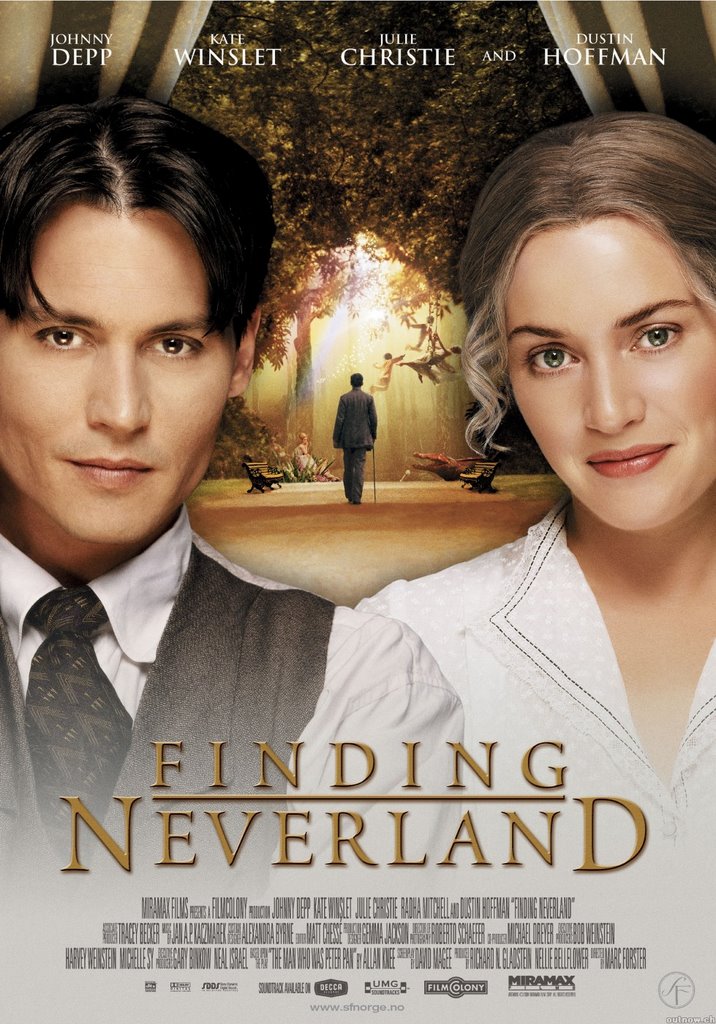
For better or worse, I’m sticking with safe ones. Like Capote (excellent morality study) or Finding Neverland (beautiful romantic excursion, with Johnny Depp too). Both tales have writers as protagonists. Both explore the extent genius is willing to traverse to find truth: the first was manipulative, and the other imaginative. On an existential level, both provide meaty food for thought and I enjoyed them tremendously. But Neverland made me cry.

Which shall it be?