Thursday, April 28, 2005
New look
So I've spruced up my blog. I don't quite know what all those add-ons will do but I hope they will keep visitors coming back. If it looks like shameless commercialisation to you, I plead guilty. In any case, I kinda like the way the blog looks and feels. Have a good day!


Wednesday, April 27, 2005
Breaking the spell
Three books that criss-cross and intersect at the very heart of our postmodern veneration of visuals and technology. Quentin Schultze calls for the rekindling of moral "habits of the heart" to resist the allure of information technologies and their triumphalistic rhetoric, while Eric Davis wonders if our obsession is a kind of techno-mysticism, a mirage, fueled by innate religious imaginings. Arthur Hunt isn't so much concerned about technology per se but he warns that the loss of the written word and the elevation of visual imageries hints at the return to paganism and opens the door to authoritarianism (after Schaeffer).
But these authors ask serious questions and raise important issues, even if they are not entirely groundbreaking in themselves (i.e, McLuhan, Postman). Knowing the impulse behind our over-indulgence in visuals and information technologies breaks their spell and lessens their power over us, so we're told. Hunt's book is the easier read (I've finished it), but the other two will need strong coffee to get me through them...after I've turned off the computer.

Quentin J. Schultze
.......................

Erick Davis
.......................
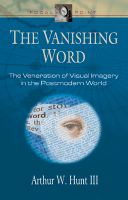
Arthur Hunt III
But these authors ask serious questions and raise important issues, even if they are not entirely groundbreaking in themselves (i.e, McLuhan, Postman). Knowing the impulse behind our over-indulgence in visuals and information technologies breaks their spell and lessens their power over us, so we're told. Hunt's book is the easier read (I've finished it), but the other two will need strong coffee to get me through them...after I've turned off the computer.

"Although information technologies increase our capacity for acquiring and disseminating information, the resulting informational practices actually foster individualism and self-interest over community and responsibility. Information technologies are not just tools but also value-laden techniques that we rely on increasingly to organize and understand nearly every aspect of our lives. As Jacques Ellul argues, this technological-mindedness is essentially a faith in la technique, the means of efficiency and control. The cover of Business Week shouts in large type, "The Infotech 100: Efficiency Rules! Who's Got It. Who's Selling It." Today, we increasingly assume that doing things quickly and effectively is more important than doing them carefully, thoughtfully, and ethically. As a result, much of our daily communication slips into junk messaging - the informational equivalent of junk food. While we gain access to more information and speedier means of messaging, we also weaken the kinds of shared practices, such as neighborliness and hospitality, that we need to maintain our moral bearings. Our manner of informational living deflates our moral character."Habits of the High-Tech Heart

Quentin J. Schultze
.......................

"Certainly Hermes would approve the Internet, a mercurial network of far-flung messages that functions as a marketplace of ideas and commodities. Accessed through the domestic threshold of home computers, the Net opens up technological liminal zone that swamps the self with new paths of possibility. Indeed, the mythic attraction of the Net turns on some of the very same qualities associated with the youthful trickster: speed, profit, innovative interconnection, the overturning of established orders. Of course, the information superhighway is also "mythic" in the modern and critical sense of the term: a strategic distortion, a mirage, a social lie. The utopian rhetoric of the Internet paves over a host of troubling issues: the hidden machinations of new corporate media powers, the potentially atomizing effects of the terminal screen on social and psychological life, and the bedeviling issue of access, as communication technologies hardwire the widening global gap between rich and poor. But Hermes prepares us for such dangers, because the merchant of messages traffics with deception: He lies and steals, and his magic wand closes human eyes forever, drawing us into the deep sleep of forgetting."TECHGNOSIS
Erick Davis
.......................

Although today it has become fashionable for scholars of human communication and spokespeople of the entertainment industry to minimize the power of the mass media, Hitler and his minister of propaganda, Joseph Goebbels, did not minimize it. To the contrary, once Hitler became Chancellor he sought to lay his hands on every media form in Germany – art, radio, the press, and film. Whereas the propaganda of the Nuremberg rallies were like annual shots in the arm, post-1933 propaganda became total under National Socialism. Goebbels, whose doctoral thesis analyzed Romantic Drama, asserted, “In propaganda as in love, anything is permissible which is successful.” Two days after his appointment to the Ministry of Popular Enlightenment and Propaganda, the little sophist said, “It is not enough to reconcile people more or less to our regime, to move them towards a position of neutrality towards us, we would rather work on people until they are addicted to us.” Goebbels made this statement in March 1933. In May he stood before a bonfire of burning books and declared, “The age of extreme intellectualism is over...the past is lying in flames...the future will rise from the flames within our hearts.” Book burning was just one aspect of the anti-intellectualism associated with Nazism. This was an attitude of the Hitler Youth. A member of the exiled Social Democratic Party observed, “[The] new generation has never had much use for education and reading. Now nothing is demanded of them; on the contrary, knowledge is publicly condemned.”The Vanishing Word
Arthur Hunt III
Sunday, April 24, 2005
Bullied to death
12-year old Nathan Jones from Essex was apparently driven to kill himself by school bullies. An internet website set up by friends in memory of Nathan condemns the pupils they claim are responsible for his death and carries a poem aimed at the bullies entitled "Because of You."
You can read the news and the poem on The Independent online here. (Hat tip: Michael Peach)
I stumbled upon this website dedicated to bully victims called Bullycide Memorial Page which has a tragically painful list of young victims.
What is shocking is the increasing number of cases reported. The same Independent online news includes this paragraph:
You can read the news and the poem on The Independent online here. (Hat tip: Michael Peach)
I stumbled upon this website dedicated to bully victims called Bullycide Memorial Page which has a tragically painful list of young victims.
What is shocking is the increasing number of cases reported. The same Independent online news includes this paragraph:
The charity ChildLine said its latest figures showed the number of desperate children calling its hotline about bullying had reached record proportions. Last year more than 31,000 victims turned to the free helpline - up from 21,000 the year before. More than 25 per cent of those who called had turned to their teachers first but felt that their fears were not being taken seriously. They also said that bullying no longer stopped at the school gates, with many being hounded in their homes through text messages. Between 16 and 20 children under the age of 16 are thought to commit suicide every year because of bullying.I don't know what the situation is like in Malaysian schools - bullying is common, but suicide is unheard of. Here's another reason to homeschool.
Friday, April 22, 2005
No stamp of approval
Lots of feathers were understandably ruffled when Minister in the Prime Minister’s Department Datuk Seri Mohd Nazri Abdul Aziz Nazri announced that Bibles in Bahasa Malaysia or Bahasa Indonesia were banned in the country. Then a day or so later, Prime Minister Abdullah Ahmad Badawi said there was no ban on Bibles in the Malay language – but they must be stamped with the words, "Not for Muslims."
Churches in Malaysia have been exercising self-censorship and add a "Not for Muslims" flasher to advertisements and publicity materials for church events for several years now (although in recent years churches have gotten wiser and are billing their public meetings "A christian event" instead). No one knows why or if there were official instructions, but there is certainly nothing in the constitution that requires churches to do that.
Now the PM is asking for Malay-language Bibles to be stamped "Not for Muslims." That’s progressive Islam for you. It may be PC to declare that Islam means 'peace,' but as a verb, the word itself means 'submission.' Christians in the country will have to pray how best to respond to something that is obviously opposed to the spirit of the gospel. One thing is sure - our space is shrinking. Fast.
Churches in Malaysia have been exercising self-censorship and add a "Not for Muslims" flasher to advertisements and publicity materials for church events for several years now (although in recent years churches have gotten wiser and are billing their public meetings "A christian event" instead). No one knows why or if there were official instructions, but there is certainly nothing in the constitution that requires churches to do that.
Now the PM is asking for Malay-language Bibles to be stamped "Not for Muslims." That’s progressive Islam for you. It may be PC to declare that Islam means 'peace,' but as a verb, the word itself means 'submission.' Christians in the country will have to pray how best to respond to something that is obviously opposed to the spirit of the gospel. One thing is sure - our space is shrinking. Fast.
Subscribe to:
Posts (Atom)